Showing posts with label 2015. Show all posts

May 24, 2015

Bits of Physics and Mathematics for Quilters


D Es passiert nicht viel quiltiges in meiner realen (nicht virtuellen) Nachbarshaft. Umso mehr freute ich mich auf die Möglichkeit, an einer Challenge teilzunehmen mit dem Namen
"Color Brings Diversity to Life" - "Farbe macht das Leben bunter", sozusagen.
Jede Teilnehmerin bekam ein 25 x 25 cm großes Quadrat des Challengestoffes:

E There are not so many quilt events in my real (not virtual) neighbourhood. The more happy I was to take part in a challenge "Color Brings Diversity to Life". I've got the 10" square of the obligatory fabric:
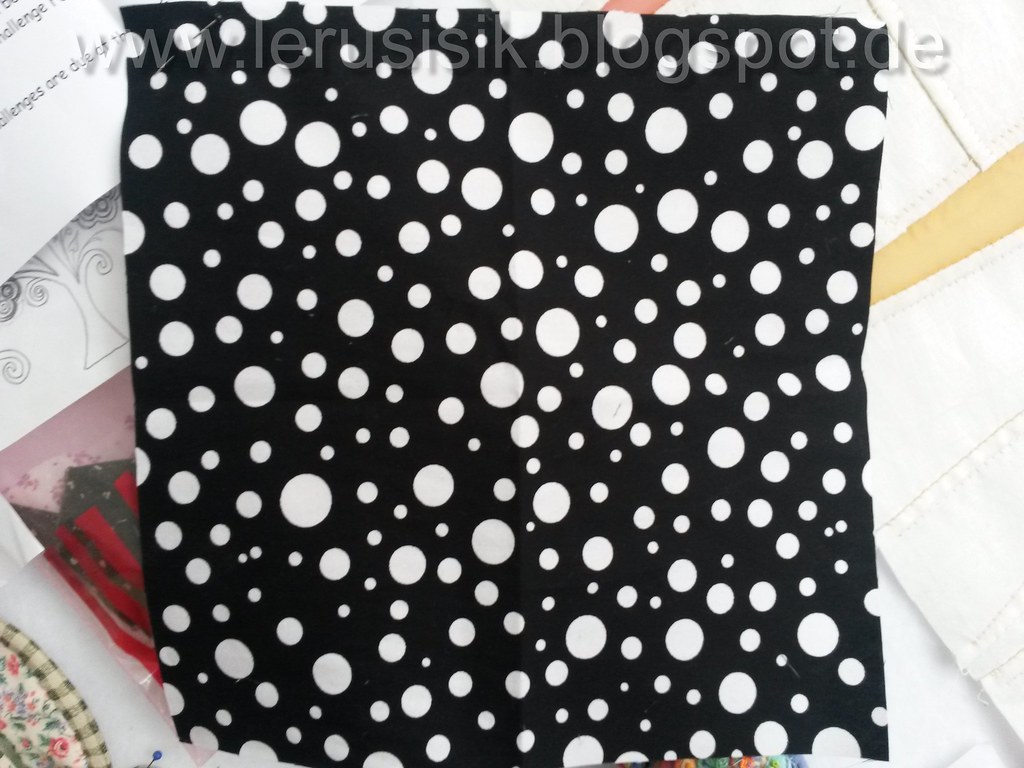

D Die Aufgabe war die Anfertigung eines Wandbehanges mit diesem Thema, dabei soll der Challengestoff im Quilt  erkennbar sein.

Meine erste Idee war, das Muster für meine schwarz-weiße Tasche weiterzuentwickeln. Im Nu hatte ich einen sehr frei geschnittenen Log-Cabin-Block gemacht, dünne farbige Strahlen draufappliziert, fertig war der Quilt. Da ich ein Riesenfan von "The Big Bang Theory" bin (die Serie, nicht die Urknalltheorie, obwohl die Theorie auch), habe ich den Quilt "The Little Big Bang" genannt. Hier ist die erste Version:

E The participants had to make a small wall hanging depicting the theme from above and using a recognizable amount of the fabric.

My first idea was to make a modified and maybe improved version of the pattern from my black and white bag. It was made quickly: a very free-hand curved log cabin + some colorful "rays". Under the influense of my favorite "The Big Bang Theory" (I mean the TV series, not a physical theory. But then again, the theory too) I've called the quilt "The Little Big Bang". Here is the first version:


D Nicht schlecht - abgesehen vom Binding. Die Einfassung gefiel mir gar nicht. Aber zu dieser Zeit hatte ich schon die Idee für den nächsten "physikalischen" Quilt mit einem Rest des Challengestoffes.
Ich legte den 1. Quilt vorübergehend beiseite and fing mit Nummer zwei an


E It was not bad except for the binding - I didn't like it at all. But at that time I had already an idea for the next nearly physical quilt. I put the first one aside and started the Experiment #2.
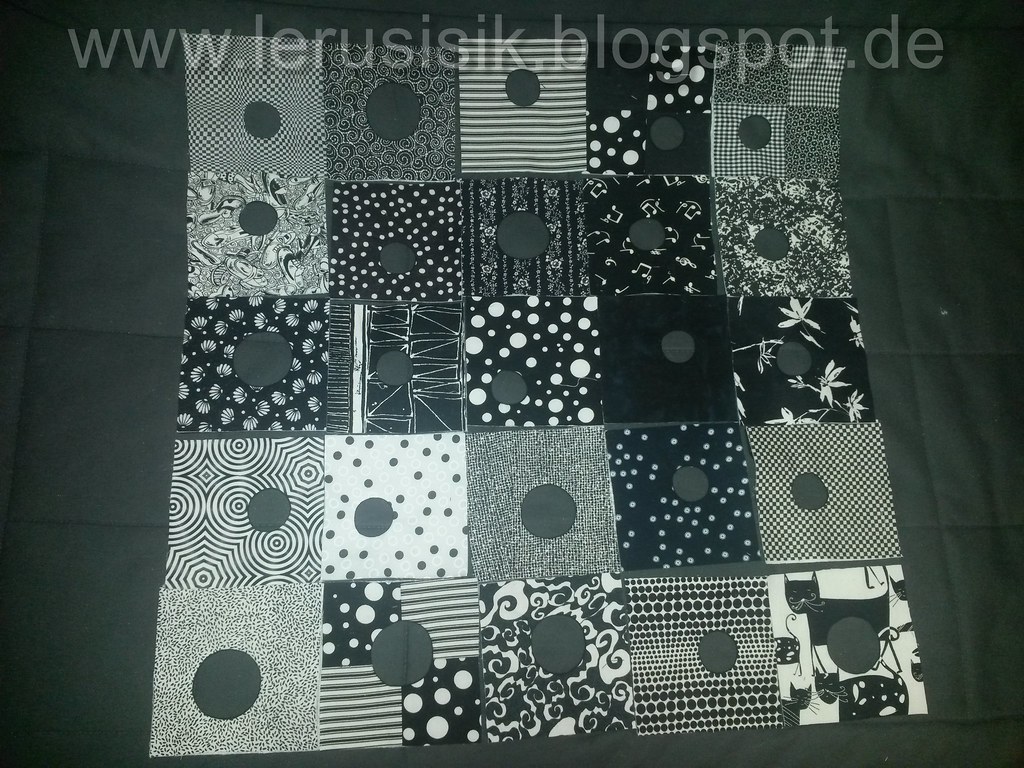

D Sorry fürs schlechte Foto, habe ich in meinem Nähzimmer am Abend bei meiner normalen Beleuchtung gemacht. (Und ich muss jeden Abend bei solchem Licht nähen!). Zu der Zeit waren es nur monochrome Löcher. Der farbige Hintergrund kam später und so entstand der Quilt "Farbige Schwarze Löcher": 

E Sorry for the poor photo, it was made at the evening in my working room (and I have to sew by that light every day night!)  It's just the holes by then, without color. Later on I added the background layer and now it calls "Colorful Black Holes" and looks like this:
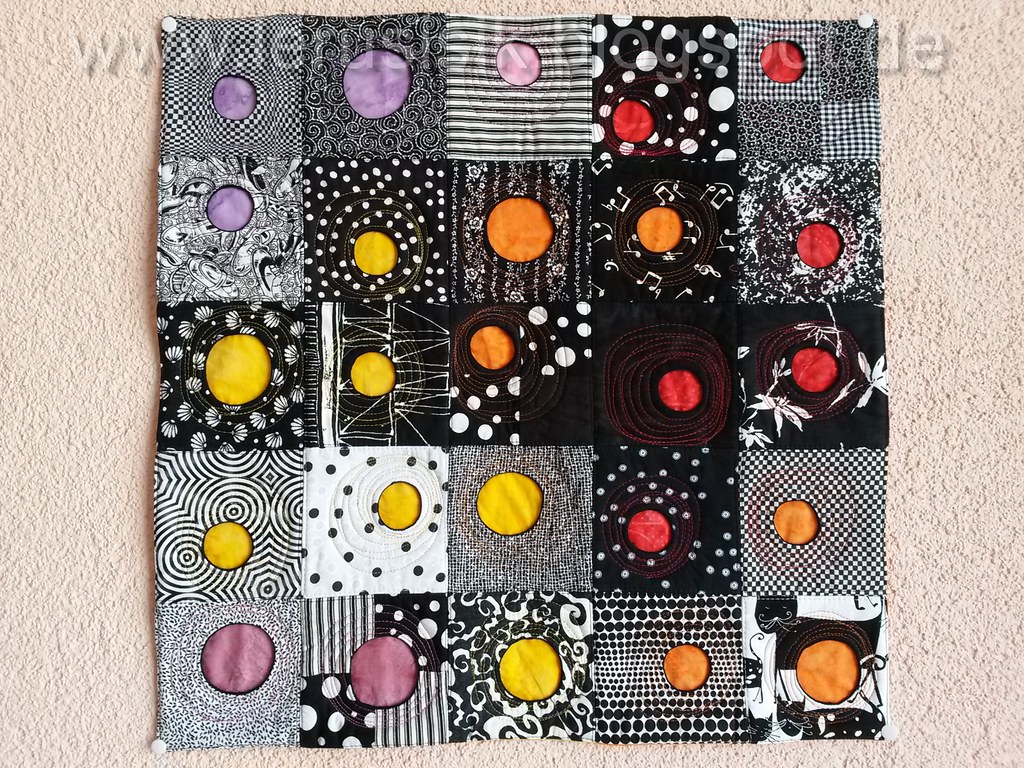
"Colorful Black Holes"

D Nachdem Nr. 2 ohne Einfassung vorlag, war mir endgültig klar, dass auch bei der Nr. 1 die schwarze Einfassung weg sollte. Hier ist also die letzte Version vom "The Little Big Bang":

E After the finishing of the second quilt it was completely clear to me that the first one doesn't need any binding at all. So I ripped off the black binding and finished the "The Little Big Bang" without a binding:
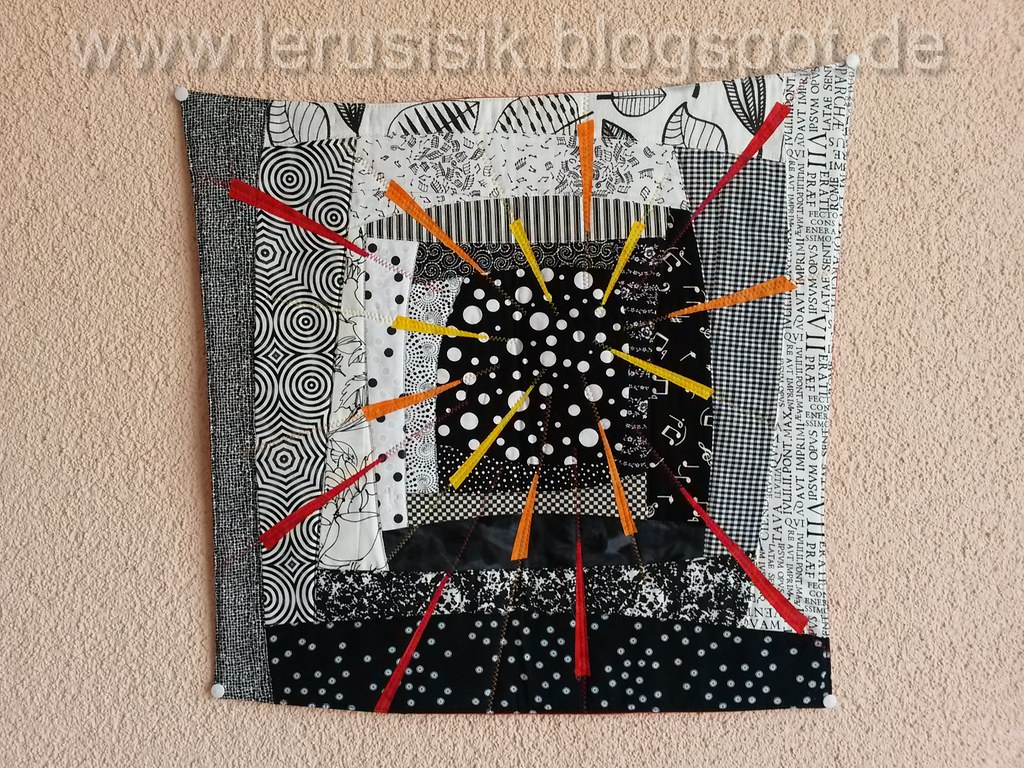
"The Little Big Bang"
D Nun hatte ich zwar keinen Challengestoff mehr, dafür aber einige weitere Ideen für "wissentschaftliche" schwarz-weiße Quilts. Deswegen bestellte ich noch ein Quadrat vom Challengestoff und fing mit dem nächsten Quilt an. Ursprünglich sollte der Name "Geordnetes Chaos" lauten. Zuerst habe ich einen (fast) schwarz-weißen Hintergrund gemacht:

E Now all the challenge fabric was gone, but I still couldn't stop producing new black and white ideas. So I've got another piece of the fabric and started the next quilt. I already knew its name - "The Ordered Chaos". I printed out the cutting pattern and  made an almost black and white background:
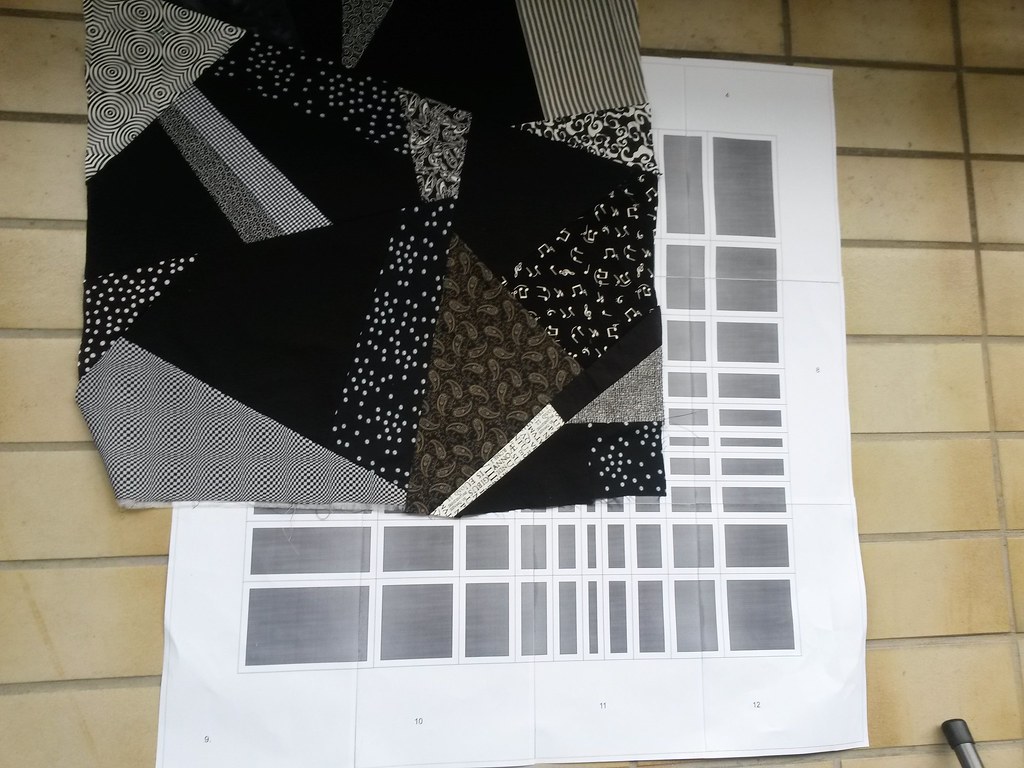

D Es sollte eine Art Verschnitttechnik mit zusätzlichen farbigen Dreiecken sein. Beim Zusammennähen habe ich jedoch bemerkt, dass der Quilt nicht besonders chaotisch wirkte. Die Fibonacci-Folge besiegte das Chaos:

E But as the piecing went further I noticed that the quilt doesn't want to be very chaotic. The order, represented by the Fibonacchi sequence, defeated the chaos:
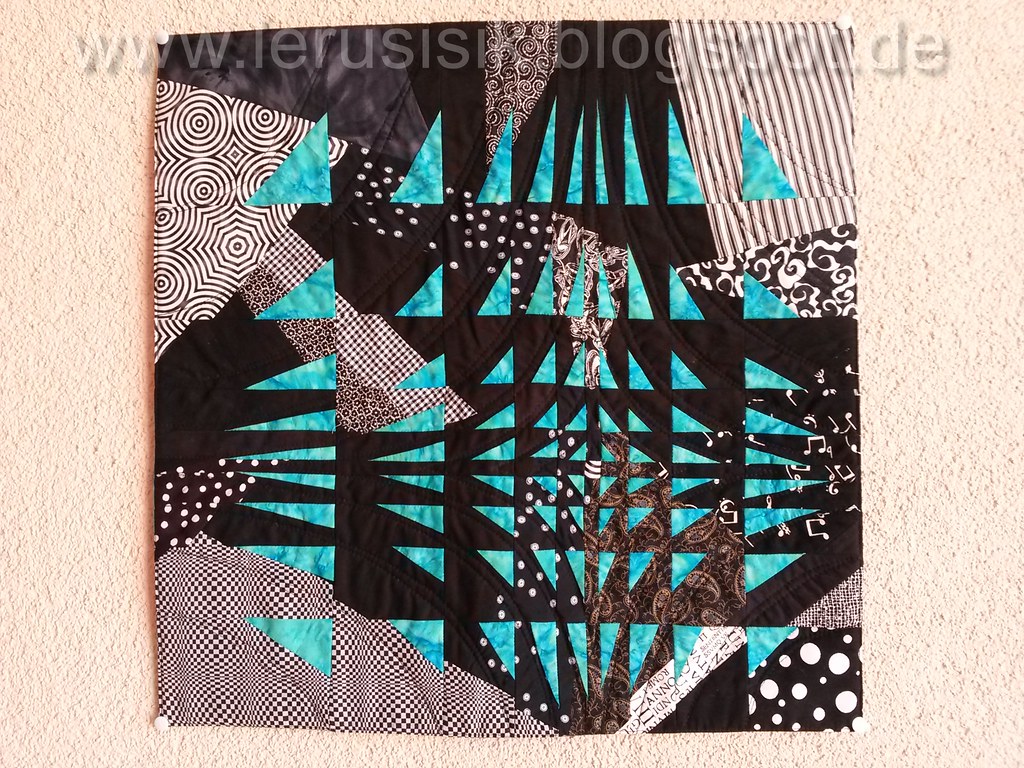

D Der Quilt heißt nun "Fibonacci Study". Wieder ohne Einfassung.

E  Da ich noch ein Stückchen vom Challengestoff übrig hatte, mußte ich noch einen Quilt machen. Diesmal versuchte ich wieder, Voronoi Diagramm in einem Quilt einzusetzen (der 1. Versuch war die Voronoi-Tasche hier). Hier kommt "Voronoi Study #2":

Now it's called "Fibonacci Study" and finished without a binding too.

Since I still had a piece of the challenge fabric I had to make another quilt. It was my 2nd approach to the beautiful mathematical object - Voronoi diagrams (the first one was the Voronoi bag here). Here comes "Voronoi Study #2":
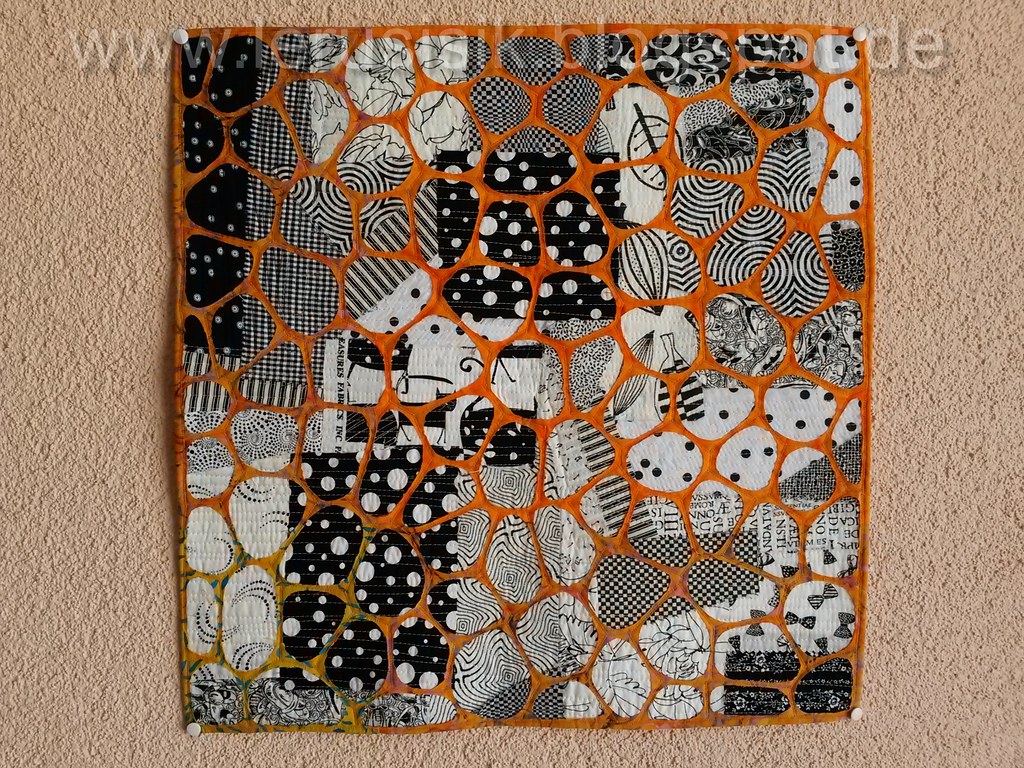


D Technisch gesehen ist der Quilt der Tasche sehr ähnlich, nur das Voronoi-Diagramm und die Stoffe sind anders.

E Technically, the quilt is very similar to the bag, it's the Voronoi diagram and the fabrics that differ. Without a binding either.

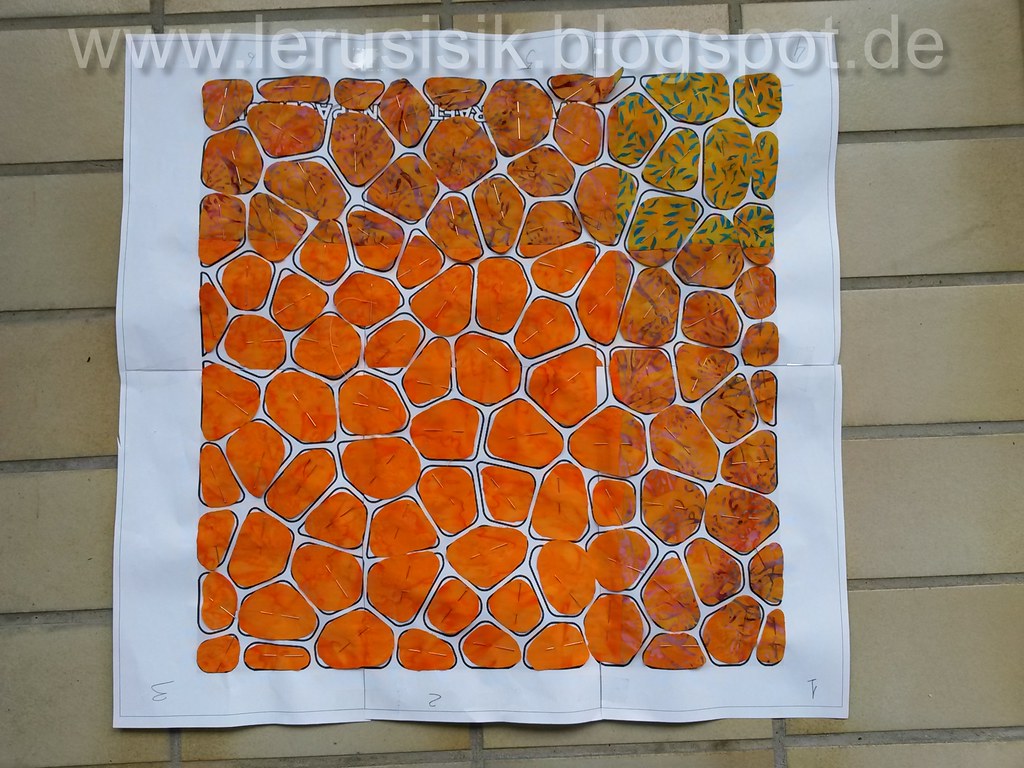
D Ich habe alle ausgeschnittene orangefarbene Stoffstücke fürs Spätere aufgehoben - vielleicht eine neue Tasche?

E This time I preserved all cut out orange pieces with the purpose of making another quilt:

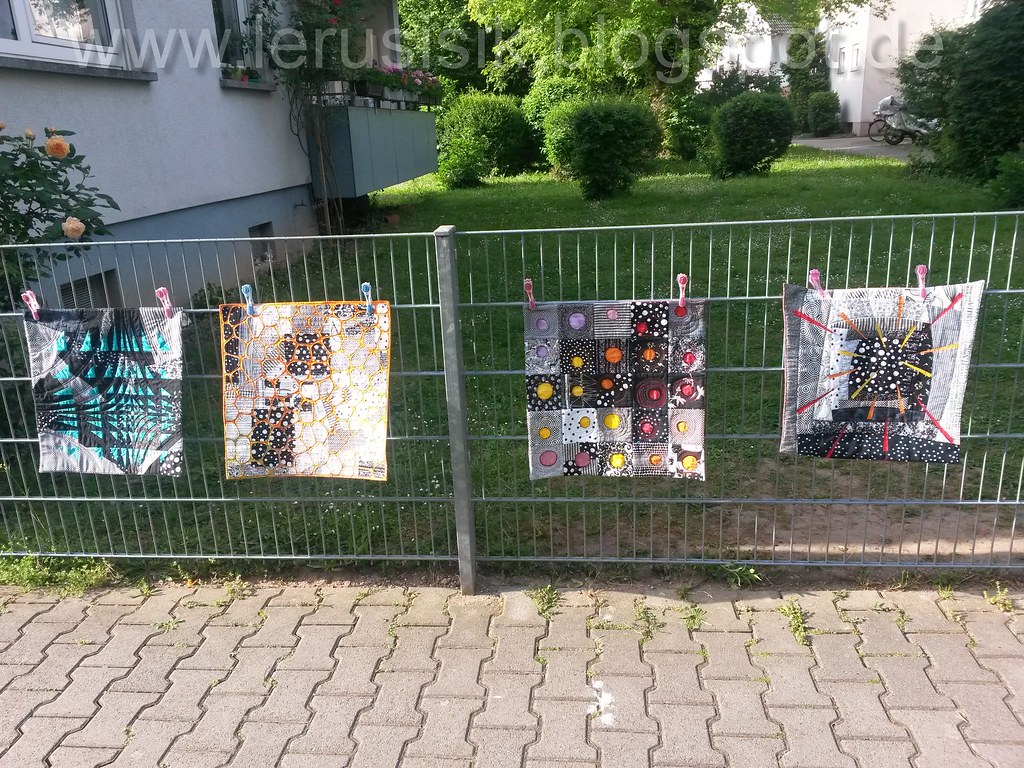
D Somit war der Stoff beinahe verbraucht. So sehen alle vier Quilts zusammen aus:

E By now, I've used almost all challenge fabric. There are all four quilt together:

P.S.

D Ich bin echt zufrieden mit den Ergebnissen. So zufrieden dass ich das "Voronoi Study #2" fürs Blogger's Quilt Festival in die Kategorie "Original Design" eingereicht. Wenn Ihnen der Quilt gefällt, dann und nur dann stimmen Sie für ihn, es wäre Freude für mich.

E I'm very happy with the results, really. So happy that I've submitted the "Voronoi Study #2" for the Blogger's Quilt Festival. If and only if you like it (the orange one) then I'd be pleased if you vote for it.

P.P.S.
And thank you for reading so far

May 20, 2015

Blogger's Quilt Festival: Voronoi Study #2

I made this quilt for a challenge "Color Brings Diversity to Life". To be exact, I made four quilts for this challenge and this is one of them.

The spots/holes/cells on the quilt are not random, they build a Voronoi diagram. Recently I've discovered this most interesting mathematical object and I'm still in awe about it! I've told about Voronoi diagrams in my previous post with a Voronoi bag (I love that bag!). Shortly: "The Voronoi diagram is a special partitioning of a plane: if there's a given set of points (called generators or seeds) then for each seed there is a corresponding region consisting of all points closer to that seed than to any other. "

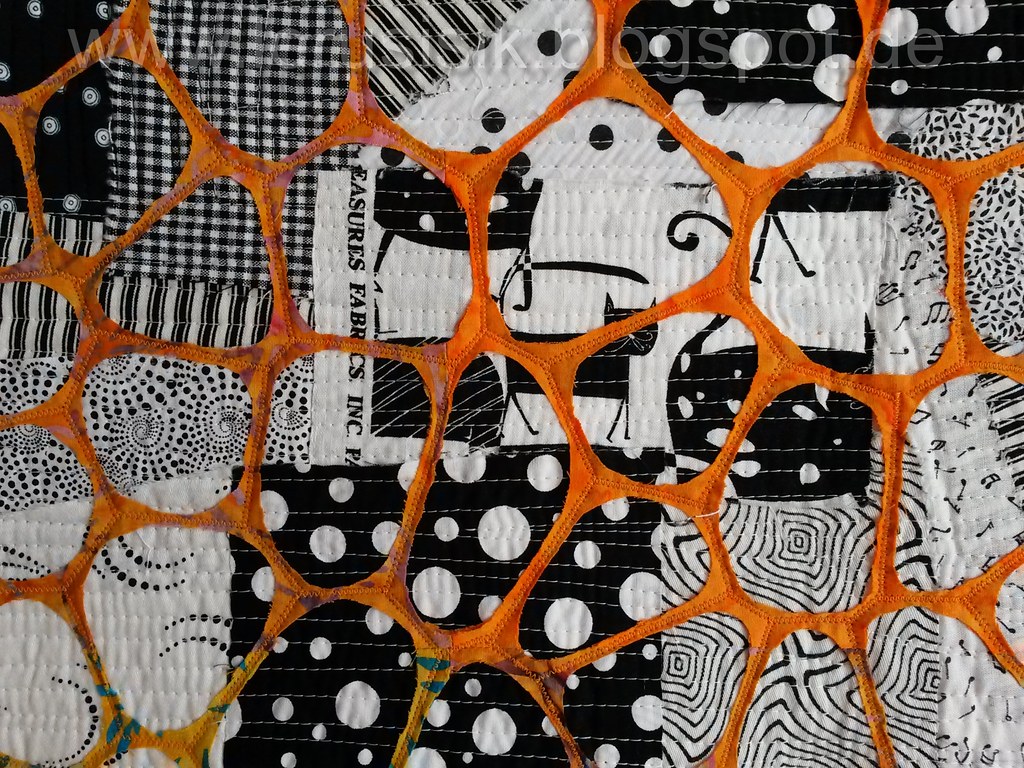
The bottom layer is just black and white scraps thrown over the interfacing and densely quilted with rather nonparallel lines. The quilting prevents exposed edges of fabrics from fraying. The black fabric with irregular white polka dots is our challenge fabric.

The top layer is  a kind of "whole-cloth raw-edge appliquee" - it's a piece of orange batik fabric, the edges of Voronoi regions were topstitched with narrow zigzag stitch, then the holes were cautiously cut out trying not to damage the bottom layer.


I've kept all cut out orange pieces and pinned them on the pattern sheet for using them later on for another bag or quilt:


I'm very happy to be able to share this quilt as a part of the Blogger's Quilt Festival!

May 6, 2015

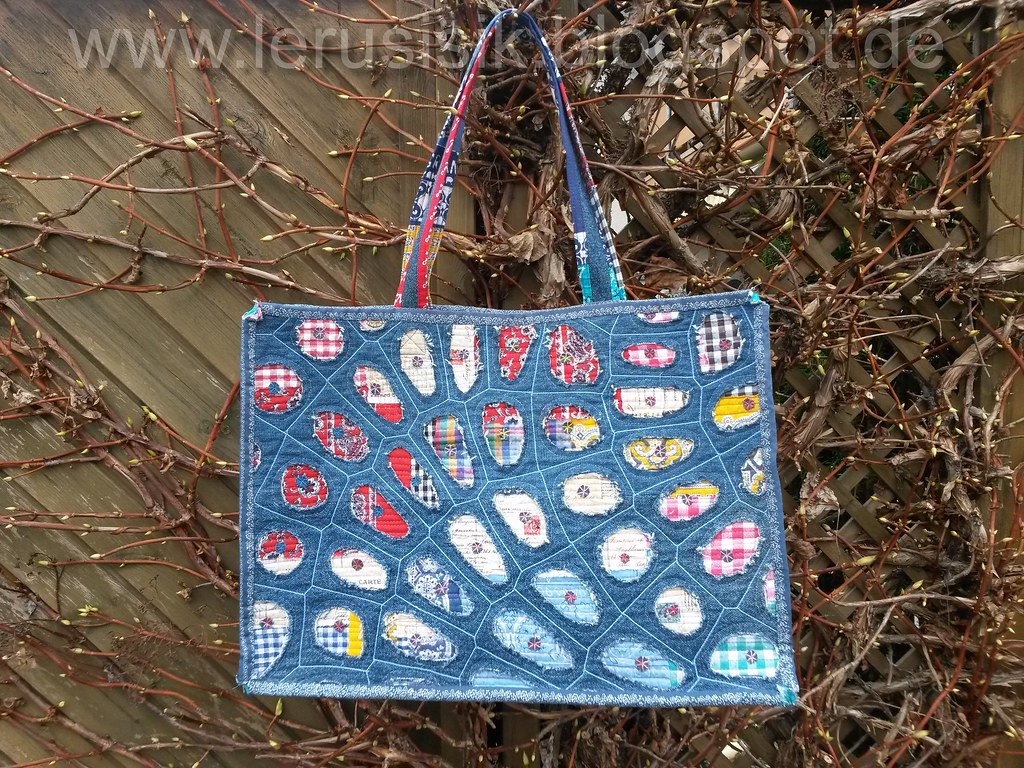
Voronoi bag

D  Es war ein reiner Zufall dass ich die Voronoi-Diagramme im Internet entdeckt habe. Nie vorher habe ich etwas darüber gehört und ich war total fasziniert mit dessen Schönheit und den Designmöglichkeiten die sie geben können.

"Die Voronoi-Zelle eines Ortes p ist die Menge aller Punkte der Ebene, die p näher liegen als jedem anderen Ort. Die Menge aller Voronoi-Zellen zu Orten aus S heißt das Voronoi-Diagramm zu S." Die Definition mag ein wenig unklar wirken, aber die Anwendungen von Voronoi-Diagrams sind so zahlreich und wichtig, dass ich mir Mühe gegeben habe, das Thema genauer zu untersuchen. Unter Anderem gibt's jede Menge naturobjekte, die wie diese Giagramme aussehen: das Muster eines Schmetterlingflügel, die Zellstrukturen, Giraffenflecken und viel mehr.

In einem 3D-Modelling-Forum habe ich ein Bild mit einem Voronoi-Diagramm gefunden, das mir besonders ansprach. Das könnte mein nächtes Quiltprojekt sein, vorerst musste ich aber die Technik und das Muster testen. Und ich habe's gemacht indem ich eine neue Tasche genäht habe!

E It was just an accident that I've found Voronoi diagrams in the internet. I never heard about them before and I was totally fascinated with the design possibilities they can give.

The Voronoi diagram is a special partitioning of a plane: if there's a given set of points (called generators or seeds) then for each seed there is a corresponding region consisting of all points closer to that seed than to any other. There are numerous applications for Voronoi diagrams, and the nature itself uses them: a butterfly wing, a cellular structure, the spots on a giraffe's body illustrate how beautiful these diagrams can be.

In a forum about 3D-modelling I found a very interesting sample of Voronoi diagrams. It could be a great quilt - I thought. But not without a test. Let me show you my test - naturally it's a bag!


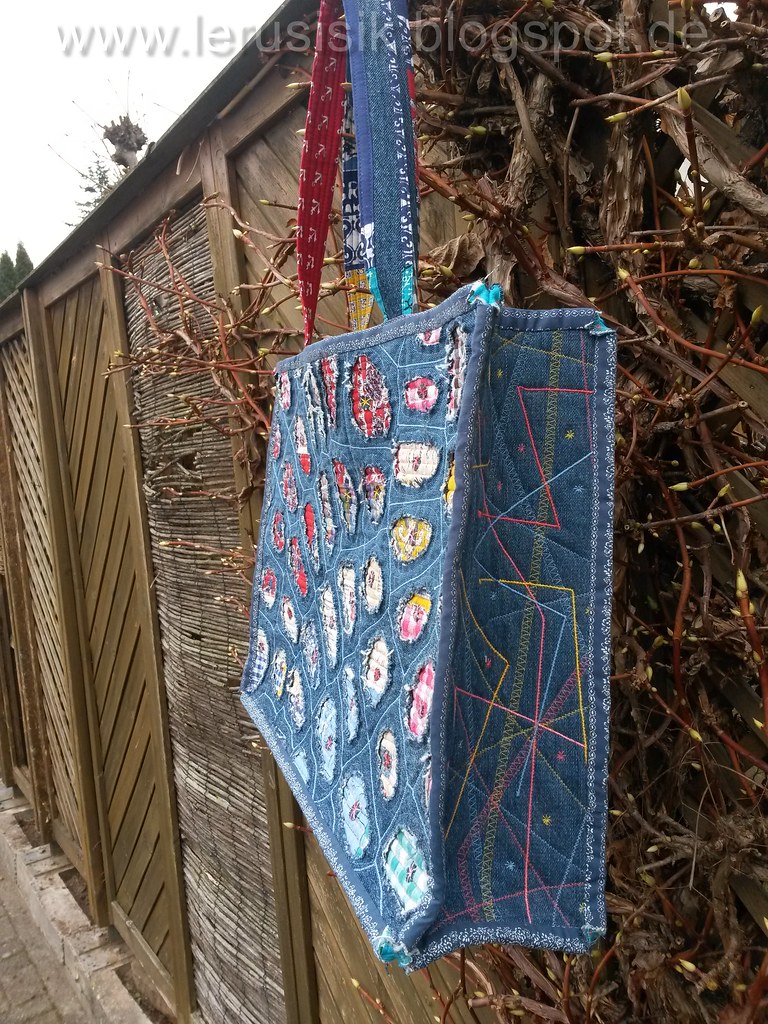
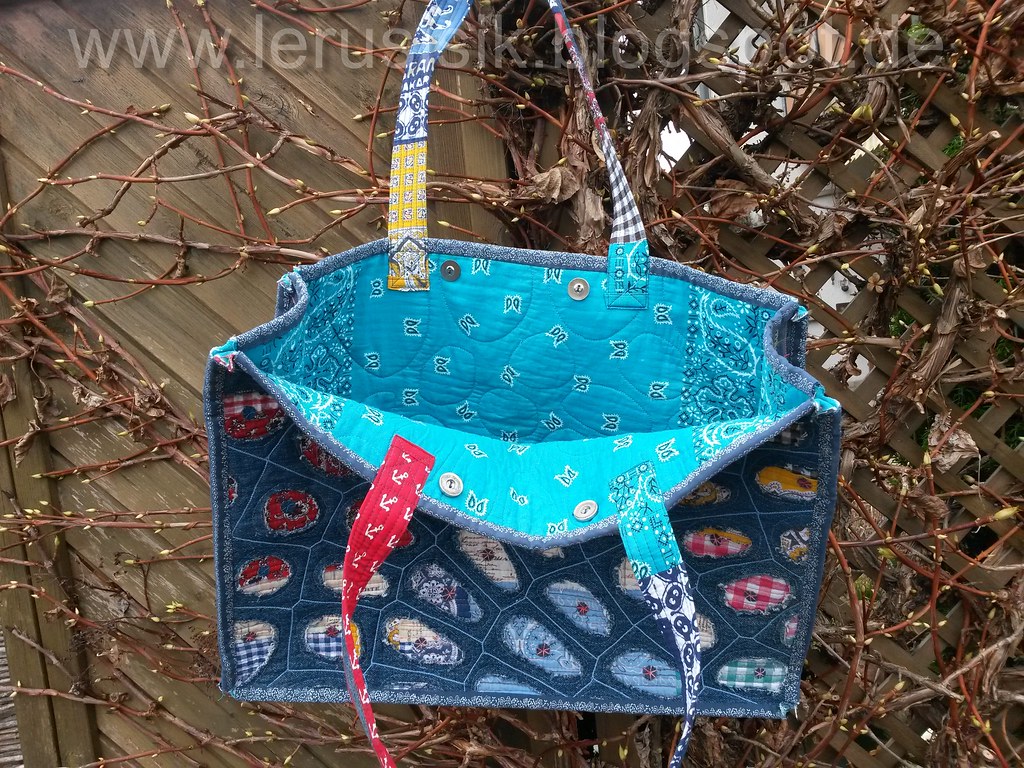
D  Das Muster auf der anderen Seite ist ähnlich, aber nicht das gleiche:

E The other side of the bag looks similar, but not the same as the first one:


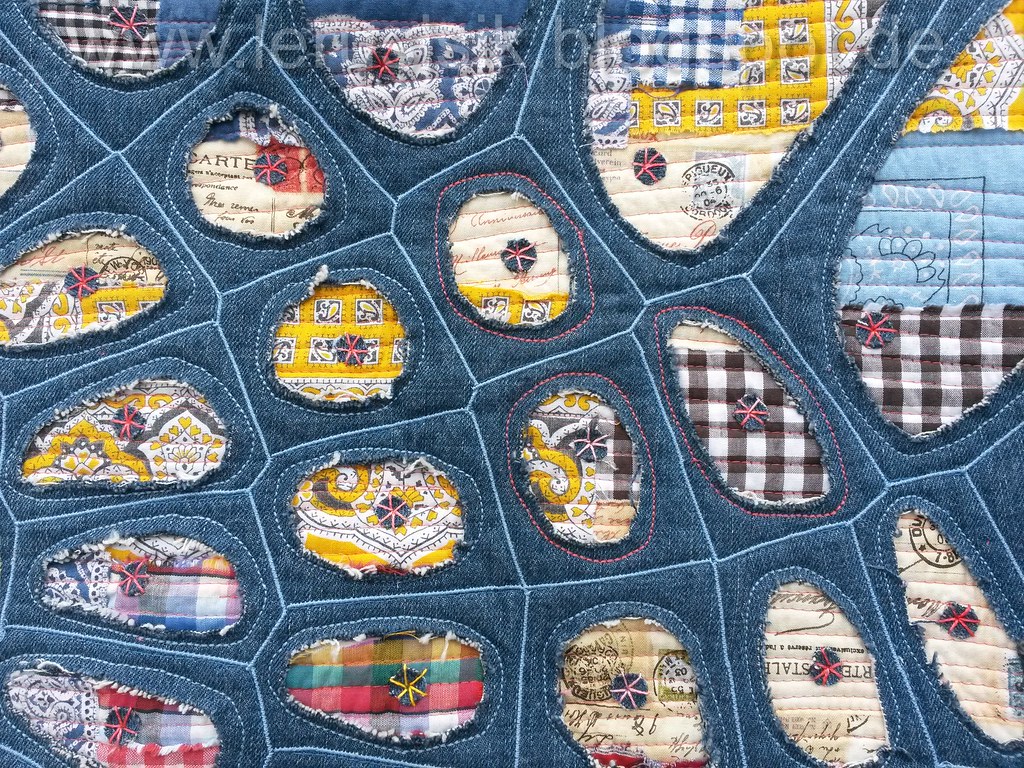
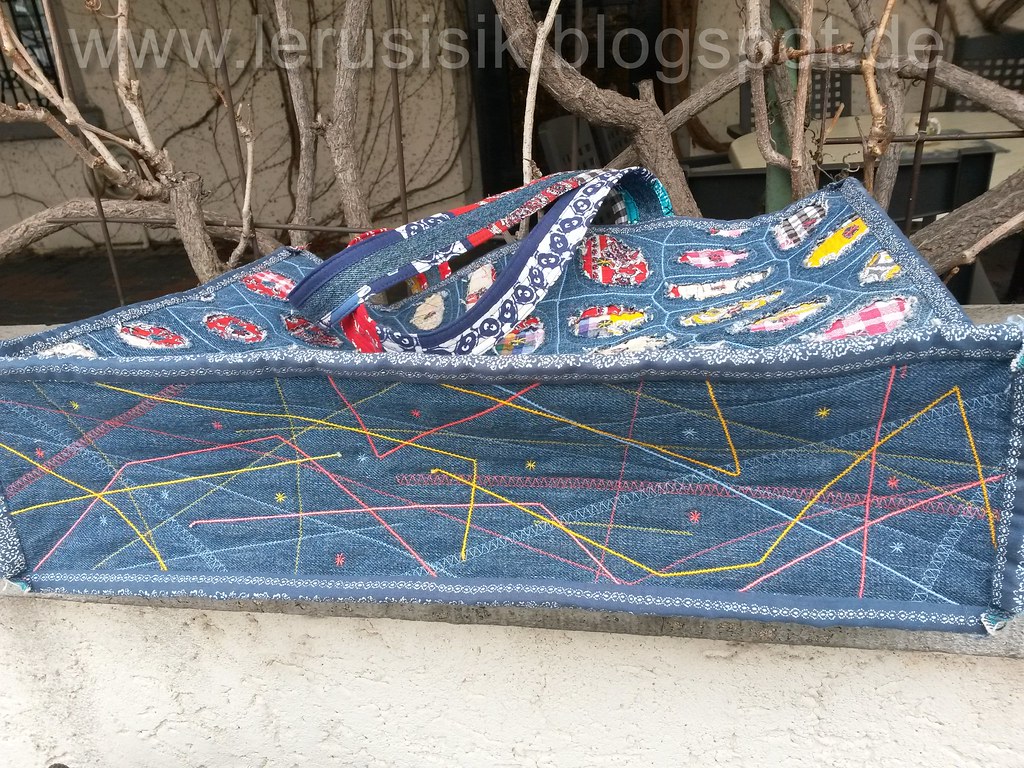
D  Die kleinen handgenähten Kreisen sind die Zentren der Voronoi-Regionen und die blauen Zickzacklinien sind die Grenzen:

E At the closeup photo the small hand sewn circles are the generators and  the light blue zigzag lines are the cell boundaries:


D  Ich habe den gesamten Nähvorgang für die Oberfläche notiert - 21 Schritt insgesamt! Einige In-Prozess-Fotos:

E I wrote down the whole process of surface building - it took 21 steps just for the front/back side, the side parts and the bottom not counting. Here are the WIP photos:


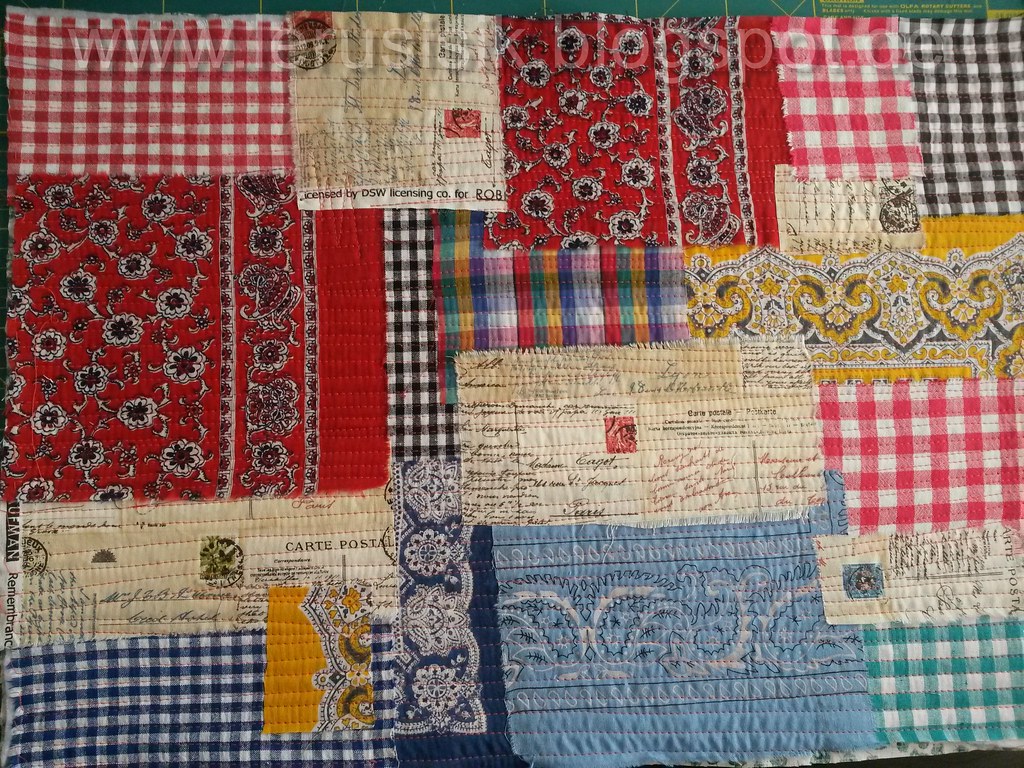
D  Die abgerissenen Stoffstücke (Bandanatücher, Karos, schöner Stoff mit Briefen) wurden aufs Thermolam gelegt und mit nicht besonders parallelen Linien dicht gequiltet

E Torn pieces of bandanas, plaids and  of a precious fabric with letters are laid on a lining and densely quilted with not very parallel lines


D  Eine Stoffbahn aus Jeansbeinen und ein Stück Pausenpapier mit dem Muster liegen obendrauf, alle Tellengrenzen sind schon nachgenäht, nun braucht man die inneren Regionen vorsichtig ausschneiden, dabei versuchen die unterliegenden Lagen nicht zu beschädigen.

Seitenteile und der Boden der Tasche habe ich anders gemacht, ohne Voronoi-Diagramme:

E The pattern was drawn on a tissue paper, the cell boundaries are already marked, now is the time to cut off the inside parts of the cells trying not to cut through the other layers.

The side panels and the bottom are made in another way:


D  Ich hatte vor, oben einen Reißverschluss einzunähen. Ich habe ihn sogar gekauft, aber irgendwie passte er nicht zu dem allgemeinen lapidaren Stil. Deswegen habe ich als Verschluss nur 2 Magnetknöpfe angenäht:

E I wanted to make a zipped closure. I've already purchased the zipper, but the bag didn't look properly with it. So I've sewn just two magnetic button as a closure:


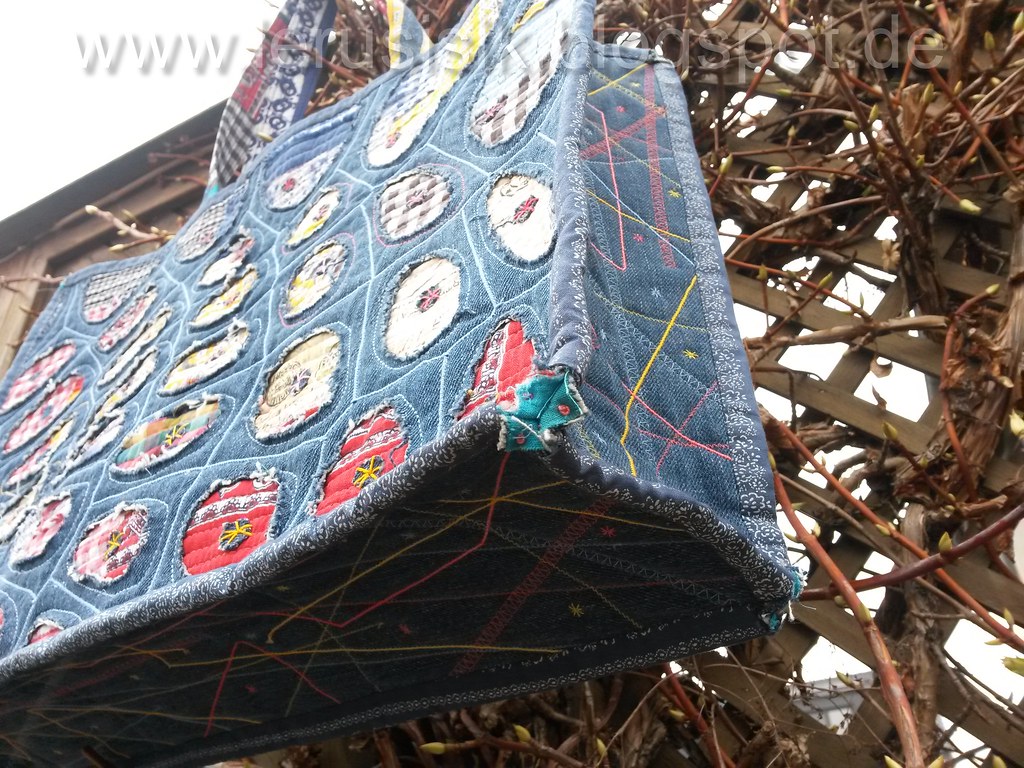
D  Die Ecken sind ein bißchen verspielt:
E And played a little with the corners:


D  Ich habe die Tasche für die Geometrie-Challenge in meiner Taschengruppe eingereicht. Nun kann ich mit dem Voronoi-Quilt anfangen, keine Tests mehr!

PS Das Bild mit Voronoi-Diagram benutze ich mit freundlicher Genehmigung von jotero

E I've submitted the bag for a Geometry challenge in my bag group. Now it's time to make a quilt, no more tests!

PS The picture with Voronoi diagram is used with the permission of the author jotero

April 19, 2015

Roses by accident

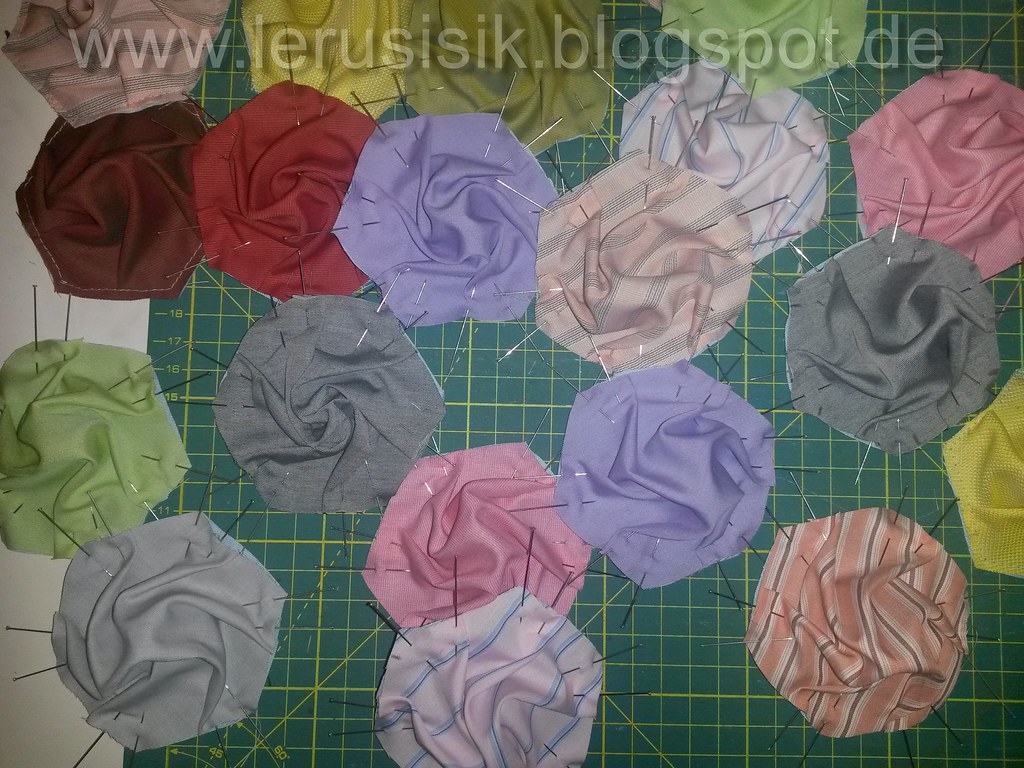
D  Während der Vorbereitung auf mein Origami-Workshop  habe ich u.A. entdeckt, dass nicht nur Quadrat, sondern auch andere gleichkantige Figuren sich für diese Falttechnik eignen. Zum Beispiel ein Dreieck: da entsteht ein Muster aus gedrehten kleineren Dreiecken. Oder ein Sechseck -  in diesem Fall sehen aber innere Hexagons ziemlich uninteressant aus. Aber wenn man den Innenteil eines gefalteten Hexagons von der linken Seite des Stoffes vorsichtig dreht, entsteht eine schöne Rose:

E While preparing for a fabric origami class I've discover for myself many interesting things. Such as: you can take another equilateral base polygon instead of a square and get another twisted block, like a triangle in a triangle for an equilateral triangle base. A hexagon in a hexagon looks rather boring, but if you turn it over and pull out the excess fabric from the wrong side and twist it, you'll get a nice rose:


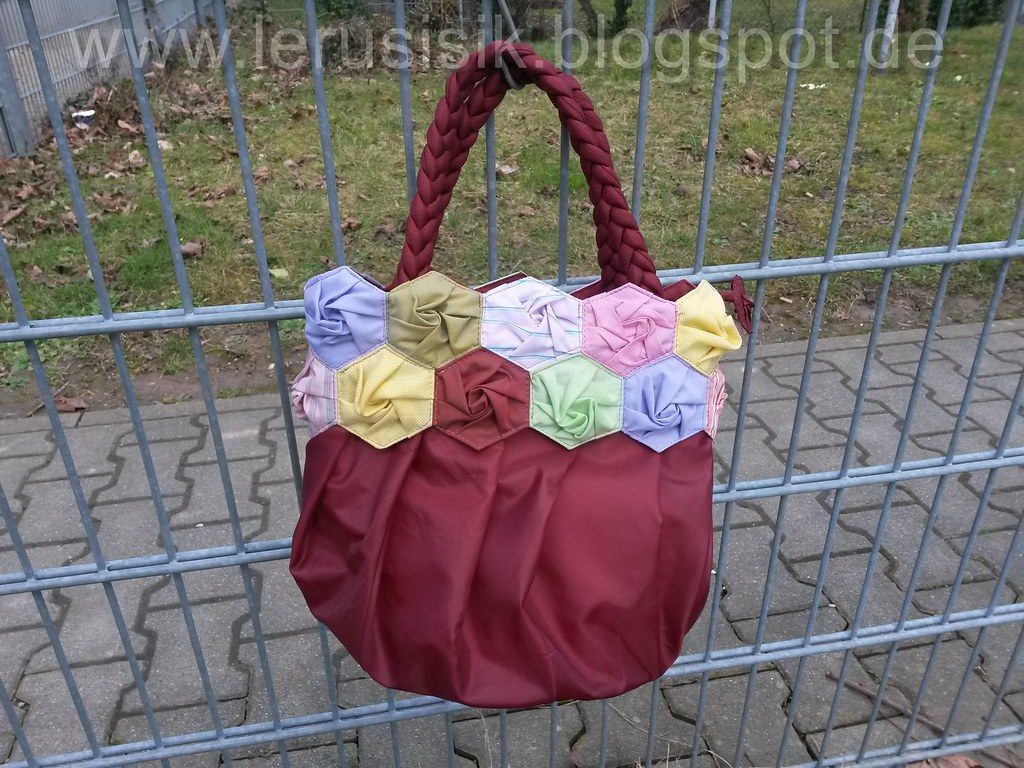
D  Diese neuerworbene Kenntnis habe ich sofort in eine Tasche umgesetzt:
E I used the newly asquired knowledge for making a purse:


D  Der Hauptstoff ist schon wieder ein recycelter Regenschirm. Die Rosen sind aus den abgeschnittenen Hemdenärmeln.
E The main fabric is a recycled umbrella, the roses are from the cut off shirt sleeves.


D  Wie immer habe ich noch ein bißchen free-motion quilting  geübt indem ich auf dem Boden Rosen gequiltet habe. Ich habe das Muster von Lori Kennedy etwas geändert, sodass ich es ohne Absetzen quilten konnte:

E I practised my free motion quilting skill on the bag bottom. I slightly altered this pattern of Lori Kennedy  to make it continuous:


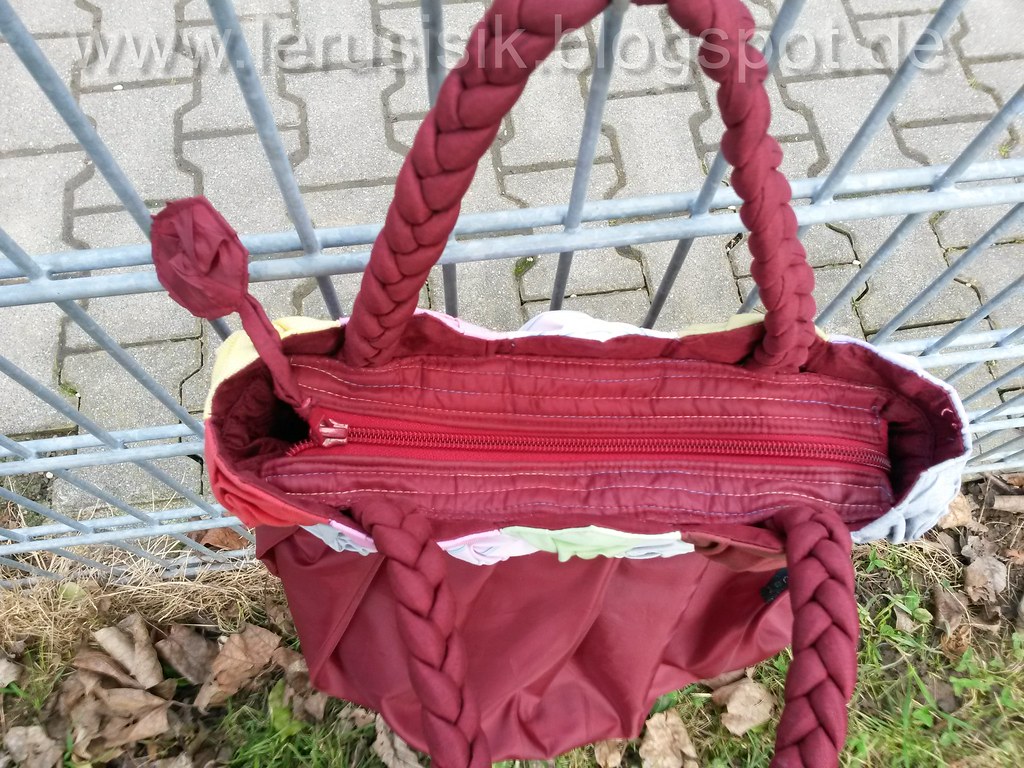
D  Zufälligerweise erinnert sich die Tasche an eine sehr bekannte japanische Tasche mit Origami-Röschen. So eine quasi-japanisch aussehende Tasche benötigte auch "japanische" Taschengriffe, die ich aus dem Futterstoff geflochten habe. Noch eine kleinere gefaltete Rose ziert den Reißverschluss:

E It's just a coincidence that the bag looks very similar to a well-known japanese bag with origami roses. Such a pseudo-japanese bag needed japanese handles too. I braided mine from the lining fabric. Another smaller origami rose embellishes the zipper tab:


D  Da Stofforigami reine Geometrie ist, habe ich die Tasche für die neue Challenge "Geometrie" in meiner Taschengruppe eingereicht. Dies war aber kein geplanter Beitrag zur Challenge. Von einer Tasche, die ich speziell für diese Challenge gemacht habe, erzähle ich im nächsten Post.

E Isn't the fabric origami the pure geometry? - I thought and submitted the purse for a "Geometry" challenge in my bag group. But it's a non-sheduled entry, my genuile "geometric" bag is to be shown in the next blog post.

April 6, 2015

Shadowfolds

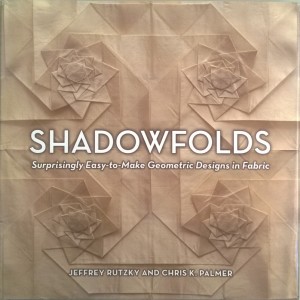
D Ich bin total fasziniert vom Buch "Shadowfolds". Ich kaufe zwar so gut wie keine Handarbeitsbücher (abgesehen von den Japanischen, die ich jedoch auch selten kaufe, da sie mir zu teuer sind), aber hier in dem Buch treffen sich Mathematik, Stoff und Origami. Mit den erstaunlichen Ergebnissen. Was für mich unwiderstehlich ist.

E I'm completely in love with the shadowfold technique. I've even purchased the book "Shadowfolds" despite of me never buying non-japanese craft books.  It joins together math, fabric and origami, who can resist such a combination. 

D Im Grunde erinnert sich das Shadowfold an canadian smocking: man näht einige Punkten auf dem Stoff mit einem Faden durch, zieht und verknotet den Faden und zupft die somit entstandenen Falten zurecht. 

Für eine Vorführung in unserer Patchworkgilde habe ich ein Teststück in dieser Technik gemacht. Anstatt von der im Buch empfohlenen Seide habe ich den wesentlich günstigeren Batist genommen und bin mit diesem Ersatz zufrieden.

Das ist das Ergebnis, mein Shadowfolds-Deckchen, rechte Seite:

E Basically, the shadowfolds technique can be viewed as a variation of the canadian smocking. It's the pattern that makes the difference.

I've made a kind of a small tablecloth for a presentation in our local quilt gild. I took cambric as a cheaper substitution for silk, it worked very good.

This is my first experience in shadowfolds. The right side:


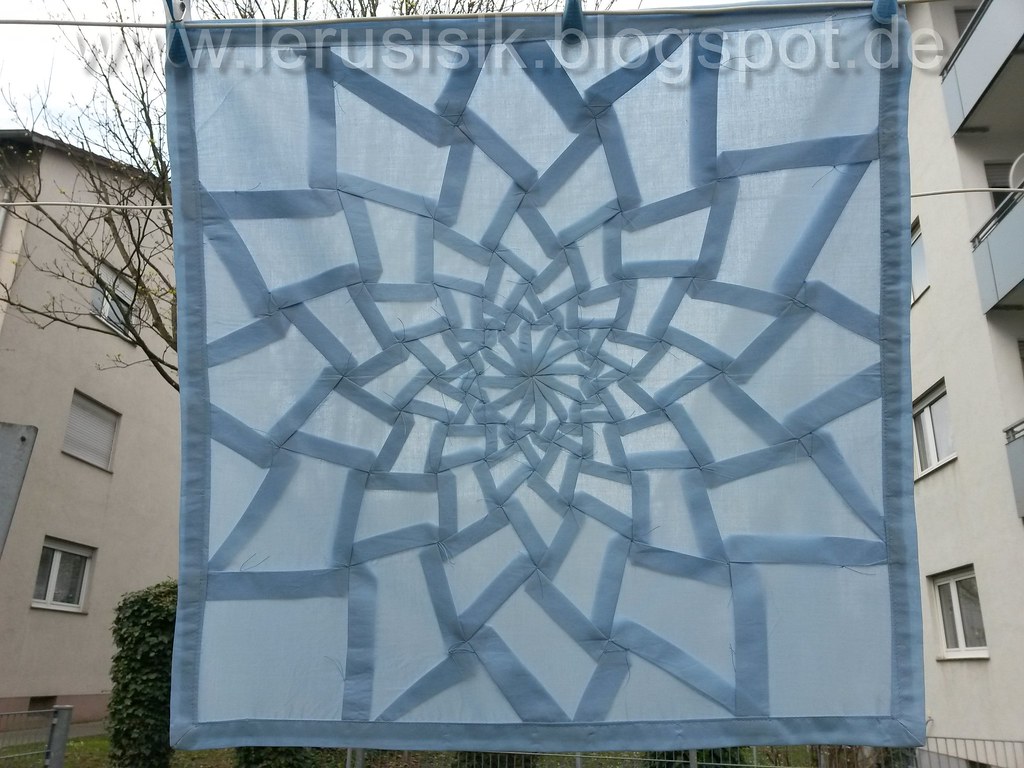
D Und hier ist die linke Seite gegen das Licht.
E ... and the wrong side with a backlight:


D Es ist sehr windig heute, deswegen fast alle Fotos sind eher geneigt. Dafür aber sieht man die gefaltele Oberfläche:

E It was really windy today, so almost all my photos are rather slanted. Like this one.  But it really highlights the fabric surface:


D Am Ende ist das Deckchen nicht schlecht geworden, aber alles anders als perfekt. Was soll ich noch verbessern?

1) Warum habe ich gedacht, dass sich die frei liegende Fäden in Falten verstecken? Die sind sehr gut sichtbar auf der linken Seite geblieben. Nächtes mal alle Ende verbergen.
2) Die Vierecke am inneren Kreis sind Quadrate, aber je weiter zum Rand, desto mehr sind sie drachenförmig und sollen anders geglättet werden.
3) Ich habe die ungewöhnliche zäckige Ränder aus dem Buch nicht geschafft, stattdessen mit einer Doppelbordüre umgefasst. Sieht ordentlich aus, ist aber nicht meine Sache.

Alles in allem, nicht schlecht fürs erste Mal.

E On the whole, the result is  acceptable, but not  perfect. There are still issues that can be improved:

1) I didn't bury the ends of the thread at all maybe hoping that they'll disappear in the folds. They didn't.
2) The polygones near to the center point are squares, but closer to the edge  they become kites and I haven't fold these kites properly.
3) I couldn't cope with a nice polygonal edge from the book and made a squared mitered border. Not too bad, but I loved the uneven edge!

Summary: not bad for the first time, but practise, practise and more practise!


March 11, 2015

All-in one, or a new issue of "Trendige Taschen"


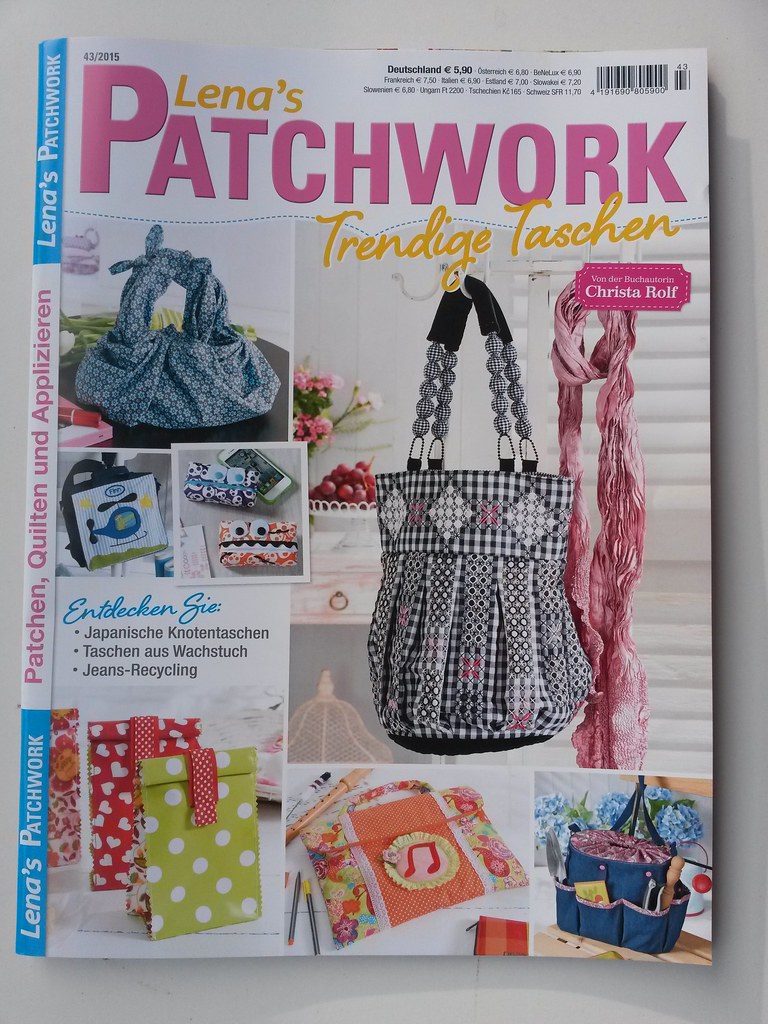
D  Mir war schon bekannt, dass meine Chicken-Scratch-Tasche auf der Titelseite des neuen Sonderheft "Trendige Taschen" erscheinen soll. Endlich bekomme ich mein Exemplar des Hefts und was für eine Überraschung!

Die schwarz-weiße Tasche ist da, wo sie hingehört, d.h. auf der Titelseite:

E I knew already that my chicken scratch bag will be at the cover of the new special bag issue "Trendige Taschen". Now I've got the advance copy  and SURPRISE!

The black and white chicken scratch bag is there as expected:


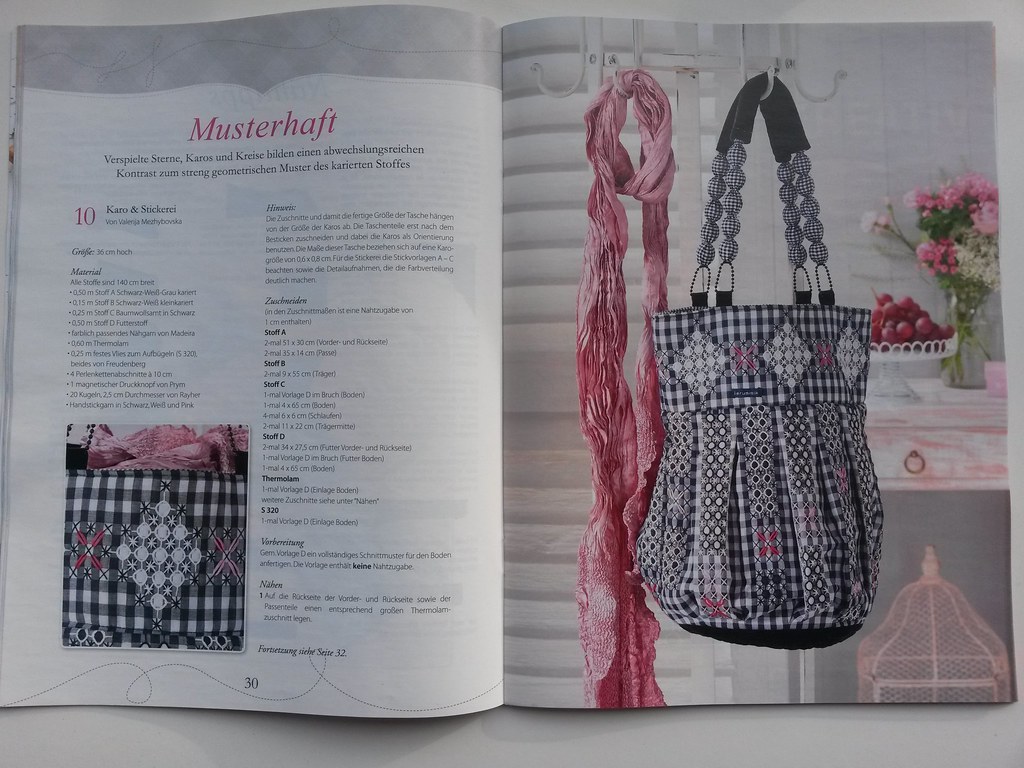
D  Und so sieht sie am ihrem Platz innendrin aus:
E And this is the inside view:


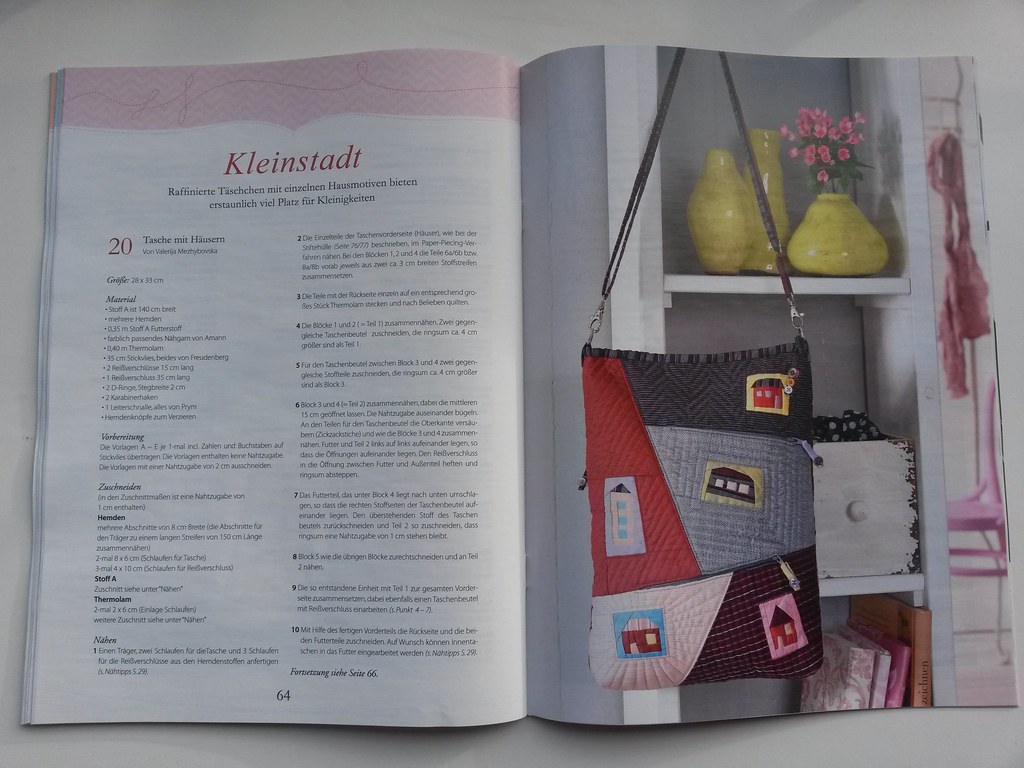
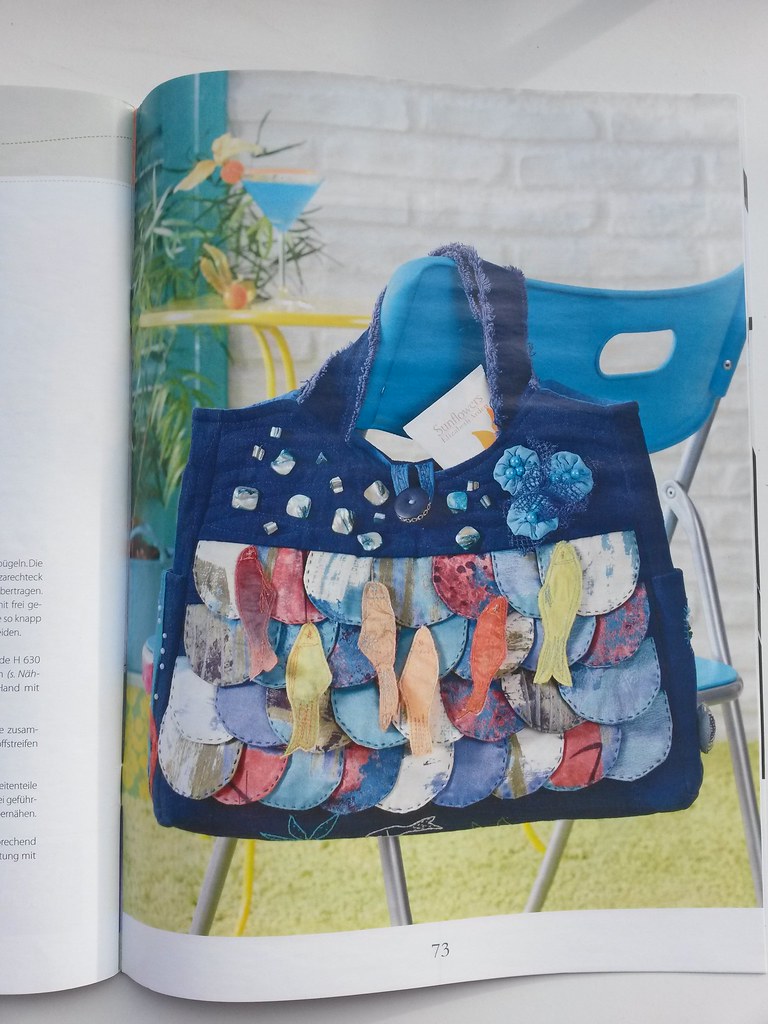
D  Von ihr abgesehen, gibt es in diesem Heft noch meine Häusertasche :
E Besides, there is my Little Village bag there:


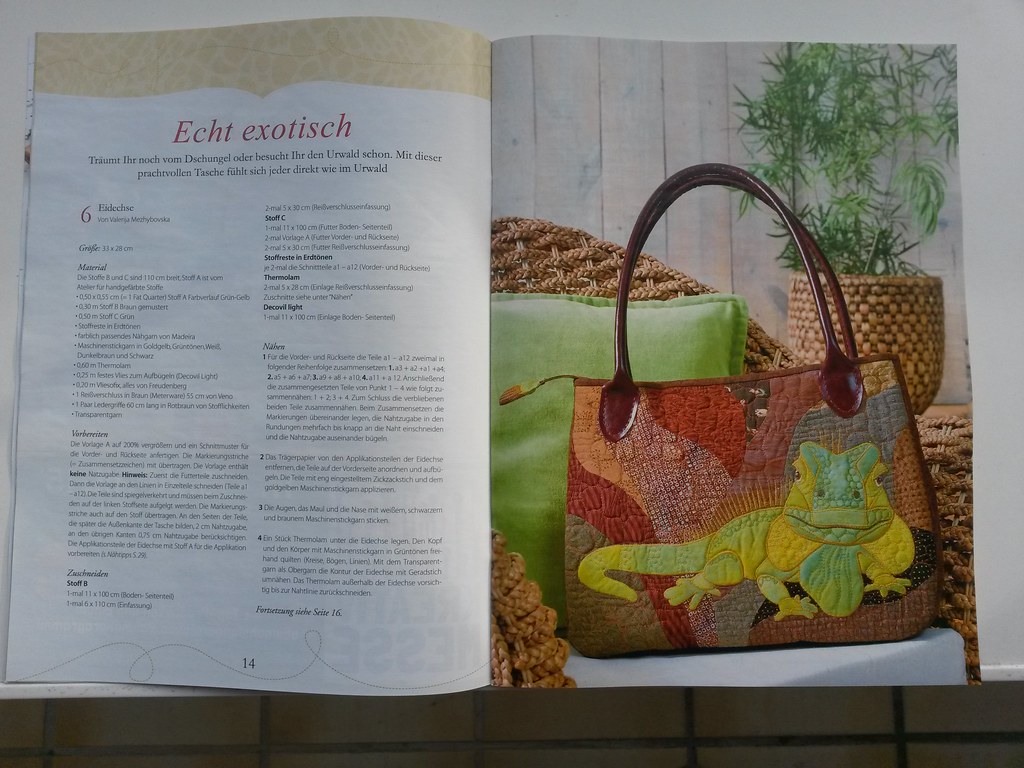
D  Dann die Leguantasche:
E And the Iguana bag:


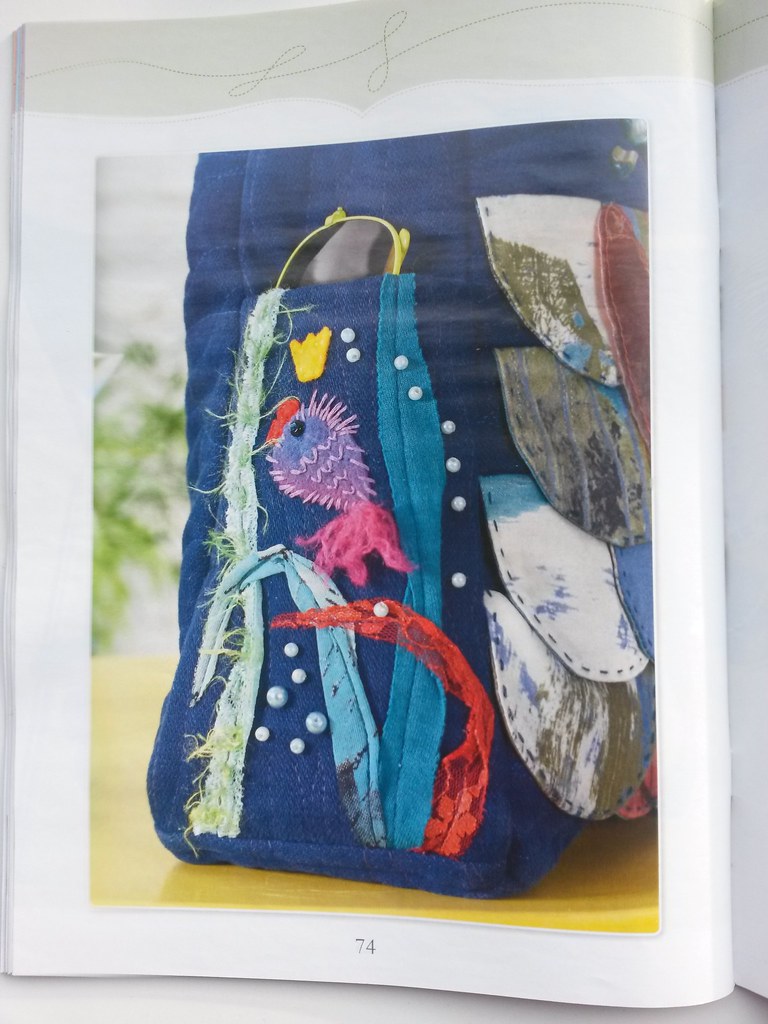
D  Gibt es in diesem Heft überhaupt etwas was nicht von mir stammt? Ja, und ob! Zwei wunderbare farbenfrohe Jeanstaschen von meiner Freundin Galina Dietz:

E Is there something in that magazine that is not mine? You bet! Two most beautiful bags from my good friend Galina Dietz:


D  Dieselbe Tasche, Seitenansicht:
E The same bag, sideview:


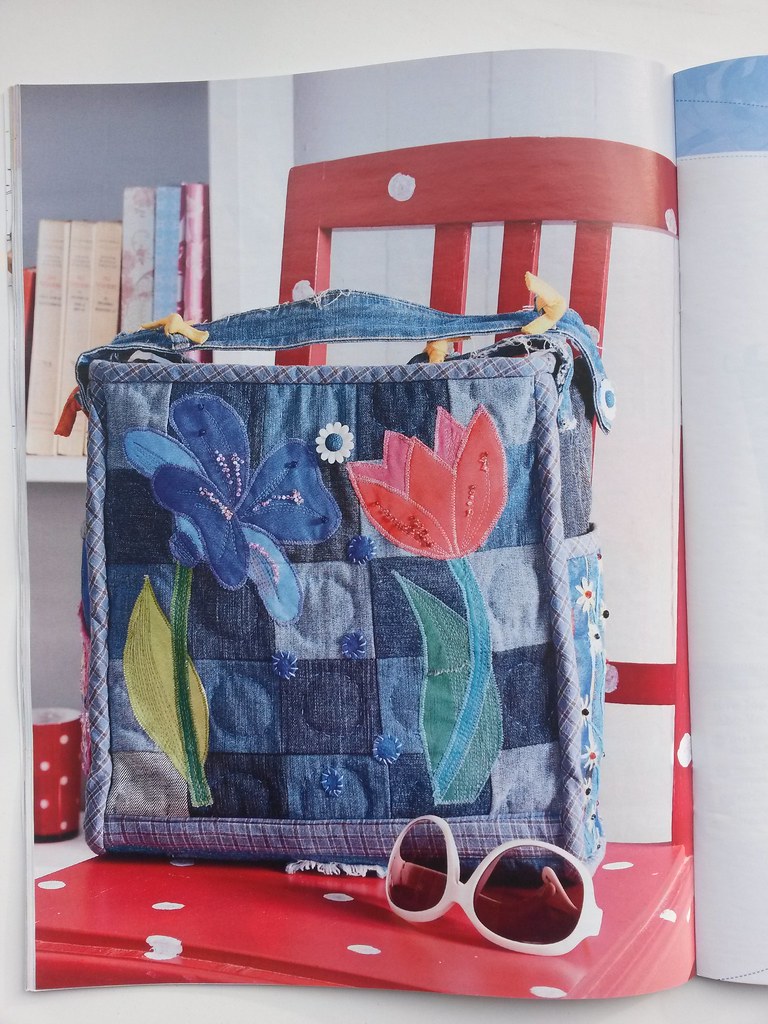
D  und noch eine mit Blumen:
E and another one with flowers:

D  Und das ist noch nicht alles von meinen talentierten Freundinnen: hier kommt der Blumenkorb von Julia Bondarenko, der Autorin von "Katz-Maus-Käse-Tasche":

E And this is not the end: here comes the denim flower basket from Julia Bondarenko, the author of the "Cat-Mouse-Cheese-Bag":


D  Also, unsere virtuelle Taschengruppe kann stolz auf sich sein! Wir haben das Heft gemacht! Und glaubt mir, wir haben viel mehr zu zeigen.

E I think our bag group can be proud. We've made this issue! And believe me, we have much more to share.

February 6, 2015

Non-traditional Chicken Scratch

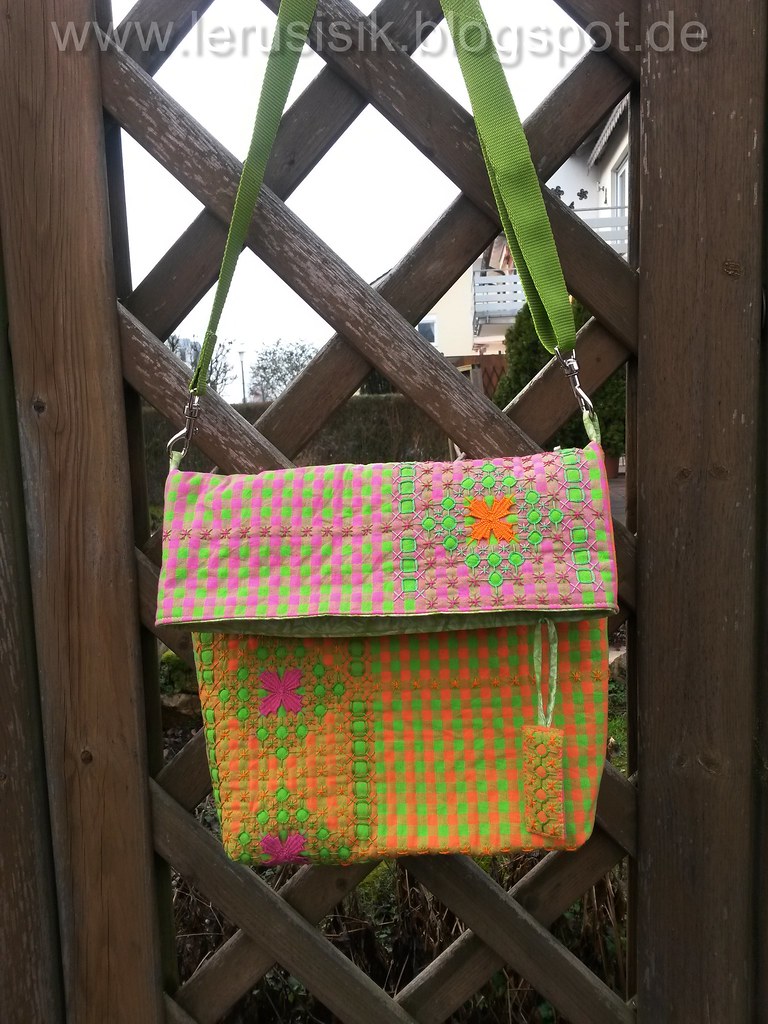
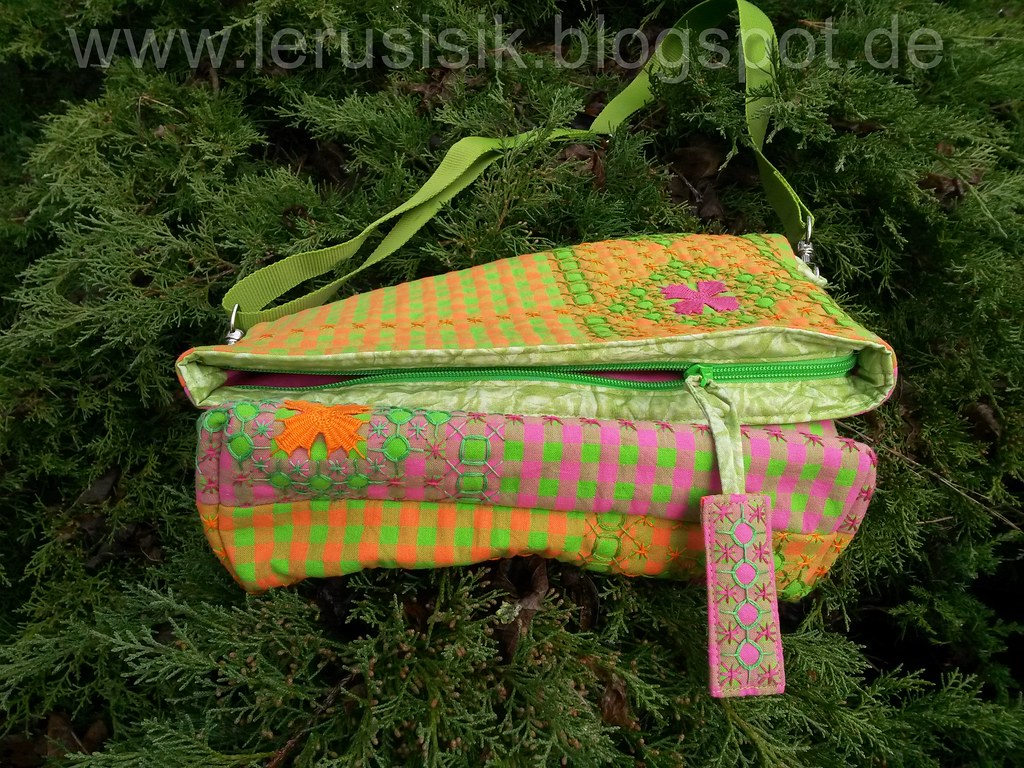
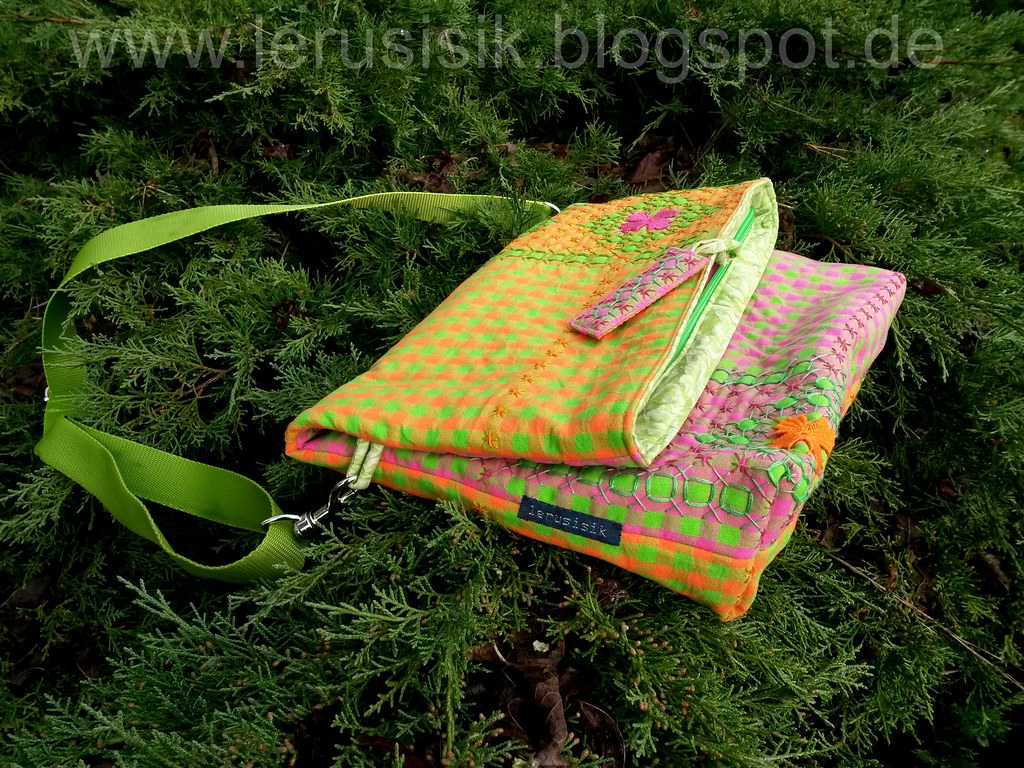
D Meine neue Tasche in der Chicken-Scratch-Technik (alias broderie suisse) ist bunt. Ich meine, ich habe zwar die für diese Technik übliche Karostoffe genommen, aber anstatt von weiß/bunt sind meine Stoffe bunt/bunt: Orange/Grün für die eine Seite und Pink/Grün für die andere.

E My new Chicken Scratch Bag has colours! I mean, I used for it traditional plaid fabrics, but with non-traditional colours such as green/pink for one side and green/orange for the other.


D Dieses Foto zeigt 2 unterschiedliche grüne Farben vom zu jeweiligenStoff passenden Stickgarn, obwohl grüne Karos sind gleich auf beiden Stoffen. Eine schöne und unerwartete optische Täuschung.
This photo shows two different greens for the embroidery, although the greens on both fabrics are the same. Nice and unforeseen optical illusion.

E Die "broderie suisse" sieht auf einem farbigen Stoff nicht so spitzenartig wie bei den "normalen" Hintergrundfarben:
Still the embroidery itself  looks not so lacy as on the usual white/coloured background:

the green/pink side

D Hier kommt die Tasche. Die Seite im Grün/Pink:
E And here comes the bag. The pink side:


D ... und in Orange/Grün:
E ... and the orange side:


D Beide Seiten sind gleich funktionell.
E You can carry the bag either side out.


D Auf diesem Foto ist nicht nur ein schöner Anhänger zu sehen, sondern auch das Quilting. Vor dem Sticken habe ich einen Sandwich aus dem Stoff undThermolam gemacht und beim Sticken beide Lagen mitgefasst, sodass der bestickte Teil gleich gequiltet wurde. Die andere Hälfte musste auch unbedingt gequiltet werden, das verleiht der Tasche die notwendige Stabilität. Andererseits, jedes sichbare Quiltmuster stört die Stickere. Deswegen habe ich die übriggebliebenen Oberflächen mit kleinen unsichbaren Stichen lediglich in den Ecken der Karos von Hand gequiltet. (Das Foto ist zum Anklicken).

E At the photo above  not only you can see the cute zipper tab (double-sided too), but the quilting is also visible. I've layered the fabric with Thermolam (the best interfacing for bags, believe me) before starting the embroidery, so the embroidered part didn't need any more quilting. But for the other part, quilting with any color would make the pattern not so clear. Therefore I've quilted it by hand with tiny detached stitches only in the corners of squares. You can see the stitches on the full size photo (on click).


D Die farbigen Quadraten auf dem Boden treffen sich gut zusammen.
E Matching squares at the bottom of the bag.

It deserves the label!

D Meine frühere Versuche der Chicken-Scratch-Technik (sehenswert):
E My other chicken scratch experiments: